Belgium's Second-Largest Bank Launches Bitcoin and Ethereum Trading for Retail Customers
KBC Bank becomes first Belgian bank to offer Bitcoin and Ethereum trading to retail customers under MiCA regulation. Trading starts February 16 via Bolero platform.

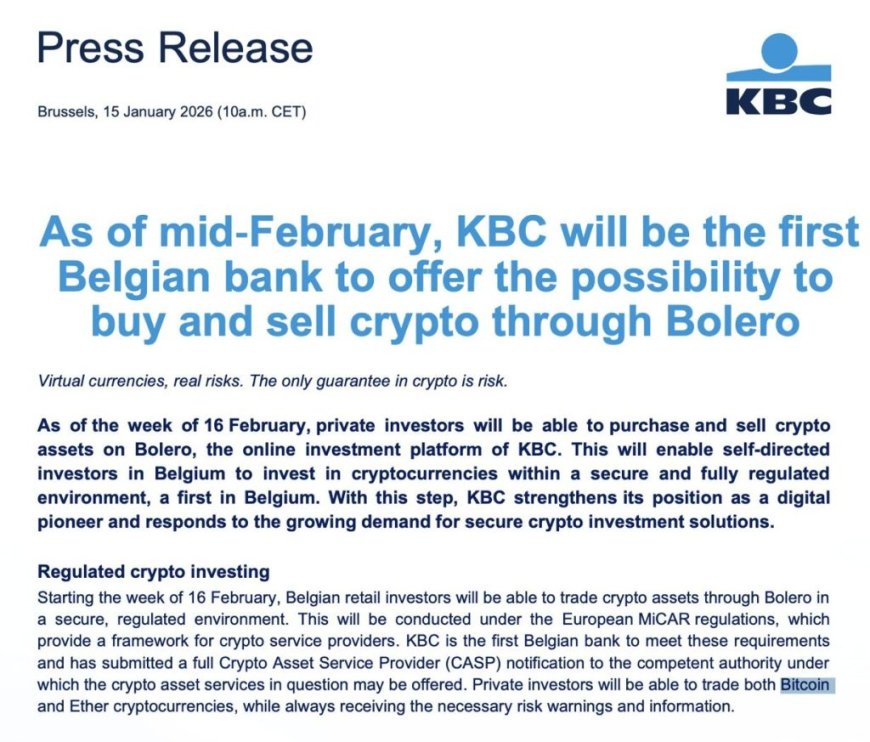
KBC Bank becomes the first Belgian bank to offer direct Bitcoin and Ethereum trading to individual investors under EU's MiCA regulation, starting February 16.
Belgium's second-largest bank, KBC Bank, is breaking new ground in the country's financial sector by becoming the first major Belgian institution to offer direct Bitcoin and Ethereum trading to retail customers under the European Union's Markets in Crypto-Assets Regulation (MiCA).
This move marks a significant shift for Belgian investors who have spent years relying on foreign exchanges like Binance, Coinbase, and OKX, or digital banking apps such as Revolut and N26 to access cryptocurrency markets. Until now, no major Belgian bank had integrated crypto trading directly into its core investment platforms.
Trading Goes Live on Bolero Platform This February
The bank announced Thursday that starting the week of February 16, Belgian private investors will be able to buy and sell the two largest cryptocurrencies through Bolero, KBC's online investment platform.
The launch follows KBC's submission of a complete Crypto Asset Service Provider (CASP) notification to relevant authorities under MiCA. Belgium only recently completed its national implementation of MiCA, with the application law published in December 2025 and the framework legally entering into force on January 3, 2026.
Oversight of crypto markets in Belgium is now jointly managed by the Financial Services and Markets Authority (FSMA) and the National Bank of Belgium.
Closed-Loop System Prioritizes Security Over Flexibility
KBC emphasized that crypto trading on Bolero will operate within a "closed loop." This means customers won't be able to transfer cryptocurrency off the platform—they can only buy and sell within the system.
The bank stated this structure is designed to reduce risks related to fraud, money laundering, and unauthorized transactions. By providing custody services through its own infrastructure, KBC also eliminates the need for customers to manage private keys themselves.
Under MiCA, Bitcoin and Ethereum are classified as "other crypto assets" since they lack a central issuer or pegged value. Still, the regulation imposes comprehensive obligations on service providers like KBC and Bolero regarding consumer protection, segregation of client assets, capital requirements, cybersecurity standards, and market abuse prevention.
Strict Risk Warnings Before Trading Access
KBC's announcement repeatedly emphasized risk disclosures, warning customers that crypto prices can fluctuate sharply, total loss is possible, and crypto assets aren't covered by deposit guarantee funds.
Bolero will operate on an "execution-only" basis—meaning customers won't receive investment advice and must make their own decisions.
Before trading, users must complete a "knowledge and experience test" measuring their risk awareness. Bolero CEO Céline Pfister said educational materials will be provided through Bolero Academy to help investors understand this new asset class during the launch.
KBC Leads Belgium's Entry Into Regulated Crypto Banking
This decision follows KBC's initial announcement in July 2025 about plans to offer Bitcoin and Ethereum trading subject to regulatory approval.
The move puts the bank ahead of local competitors while aligning with broader European trends. According to a recent industry report, more than 60 banks across Europe already offer some form of crypto-related services.
KBC's decision demonstrates that even as regulators across Europe tighten oversight of digital assets, traditional financial institutions face mounting pressure to respond to ongoing retail demand for cryptocurrency access through regulated, secure channels.